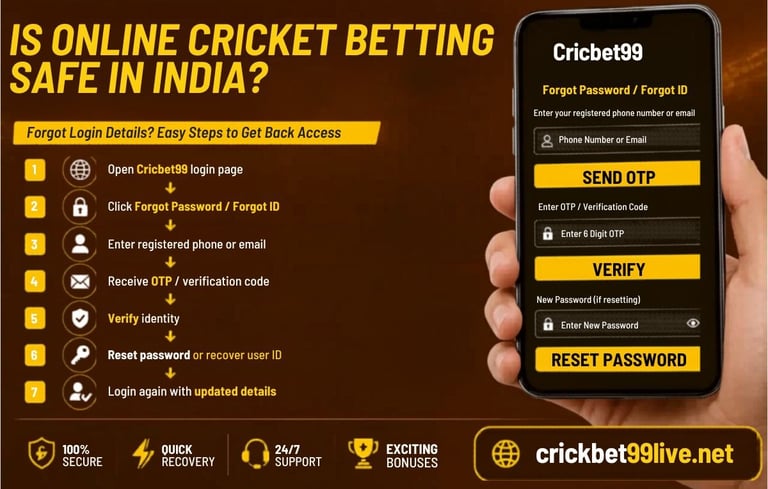
Is Online Cricket Betting Safe in India? Legality & Risk Guide (2026)
Cricket enjoys massive popularity across India, and millions of fans follow live matches with intense excitement. Alongside this passion, a growing number of enthusiasts explore the digital space to place wagers. However, one critical question remains at the forefront: Is online cricket betting actually safe?
The answer involves a complex combination of local legal codes, financial vulnerabilities, and platform reliability. Because national guidelines can feel highly confusing and vary dramatically from one state to another, this guide breaks down the true legal status, key operational risks, and essential safety measures required to protect your digital identity.
Online Cricket Betting ID Providers (2026) – ₹100 Bonus
Online cricket betting in India operates within a distinct legal grey area because there is no unified national law governing internet-based wagering. While the platform safety depends entirely on choosing fully verified, licensed, and encrypted providers, users must first confirm their local state regulations to avoid crossing strict regional legal boundaries.
Understanding Online Cricket Betting in India
The modern landscape of sports gaming exists heavily online, with numerous digital platforms actively accepting Indian sign-ups. The core reason a legal grey area persists is that the vast majority of these betting web domains operate offshore, setting up their corporate servers outside of Indian borders.
The primary legislative document, the Public Gambling Act of 1867, was established long before the advent of the internet and modern smartphones. Because it lacks explicit language regarding web-based data routing, offshore platforms continue to market their services widely. When users search for common portals like a cricbet99 login or custom online cricket IDs, they are interacting with these external frameworks.
Is Online Cricket Betting Legal?
The legal status of sports betting cannot be summed up in a simple yes or no. Under the Constitution of India, individual state governments hold the explicit right to formulate their own localized laws regarding gambling and gaming activities.
This division creates vastly different legal environments across the country:
Regulated Regions: States like Goa and Sikkim have established framework exceptions that permit licensed physical casinos or specific, regulated online lottery and gaming services.
Skill-Based Exemptions: Certain territories distinguish between games of pure chance and games where statistical knowledge or skill influences the outcome, providing legal allowances for fantasy sports formats.
Strict Prohibitions: Conversely, multiple states have updated their local police acts to explicitly ban all forms of online gambling, including sports wagering, within their territorial jurisdictions.
Because of these discrepancies, anyone looking into alternative access systems must carefully research their specific state laws first, as local restrictions take absolute precedence over national ambiguities.
What Makes Online Betting Risky?
Interacting with unverified digital platforms exposes users to serious cyber security and financial vulnerabilities. When a platform operates without legitimate oversight, several key risks emerge:
Risk Category Specific Threat Operational Impact Platform Fraud Fake clone websites mimicking authentic interfaces. Immediate theft of user login credentials and security passwords. Financial Security Unfair withdrawal rejections or sudden banking delays. Loss of deposit balances with zero legal consumer recourse. Data Exposure Absence of Secure Sockets Layer (SSL) data encryption protocols. Personal identification files and banking data leaked to third parties. Behavioral Vulnerability Lack of spending caps leading to emotional chasing of losses. Severe personal financial strain due to undisciplined spending habits.
Features of a Safe Betting Platform
If you choose to participate in online sports tracking, prioritizing verified security infrastructure is essential. Legitimate, safe platforms consistently display the following characteristics:
1. Licensed and Verified Status
Trustworthy international operators explicitly display their active licensing details—such as certification from recognized global gaming jurisdictions—directly on their homepages. Unlicensed portals operate entirely outside legal frameworks, meaning if a dispute arises regarding your balance, you have no formal customer protection authority to appeal to.
2. Robust Network Security
Ensure the platform employs end-to-end data encryption. This is easily checked by looking for the lock icon in your browser's URL address bar. Additionally, safe networks mandate two-factor authentication (2FA), requiring a unique mobile text OTP code alongside your standard account password during every login attempt.
3. Built-In Responsible Gaming Tools
A safe environment prioritizes player protection over continuous spending. Secure websites provide clear dashboard settings allowing users to set daily or monthly deposit caps, alongside temporary self-exclusion options to halt account access whenever necessary.
How to Stay Safe While Navigating Online Platforms
Minimizing your digital exposure depends entirely on applying strict personal discipline and checking security protocols before sharing any personal information:
Conduct Thorough Brand Research: Never register on an unknown platform based solely on a promotional text or advertisement. Read independent public reviews on trusted forums to verify if other users experience smooth withdrawals.
Enforce a Strict Personal Budget: Treat sports tracking strictly as a form of paid entertainment, never as a reliable source of secondary income. Decide on a fixed budget beforehand and never increase your limits to chase past losses.
Disregard Unrealistic Profit Claims: Be highly skeptical of platforms or tipster channels promising guaranteed daily payouts or flawless winning formulas. Sports events are inherently unpredictable, and exaggerated claims are typical signs of phishing scams.
Key Takeaways
Online cricket betting remains structurally un-regulated at a national level, falling into a clear legal grey zone within India.
Individual state codes dictate absolute legality; an online activity permitted in one region may be strictly illegal in another.
Interacting with unverified platforms leaves users vulnerable to data theft, profile hijacking, and frozen withdrawal balances.
Verifiable security standards—including SSL web encryption and mandatory mobile OTP checks—are non-negotiable requirements for safe browsing.
Frequently Asked Questions (FAQs)
1. Is online cricket betting legally recognized throughout India?
No, it is not universally recognized. India lacks a singular comprehensive law for digital wagering, meaning the true legal status depends entirely on the strict regulations enacted by your specific state government.
2. What should I look for to verify if a betting site is secure?
Always confirm the website URL uses secure HTTPS encryption, look for an active international operating license code on the page footer, and check for the presence of mandatory two-factor login verification options.
3. Can digital sports platforms ensure fixed financial returns?
Absolutely not. All sports wagering carries inherent financial risks, and no legitimate system can guarantee constant winnings. Responsible utilization requires treating the platform solely as an entertainment cost.
Conclusion
Navigating the online cricket betting landscape safely requires continuous vigilance and an objective understanding of regional laws. By avoiding unverified offshore links, verifying network encryption standards, and practicing absolute financial discipline, you can successfully insulate your personal data and funds from online threats. Prioritize digital safety and manage your web footprint responsibly.
Disclaimer
The information detailed within this article is compiled exclusively for educational, technical analysis, and legal awareness tracking purposes. We do not operate, promote, or endorse any online sports betting platforms or wagering services. Digital accounts carry severe financial risks and users are completely responsible for ensuring full compliance with their respective local, state, and federal laws.